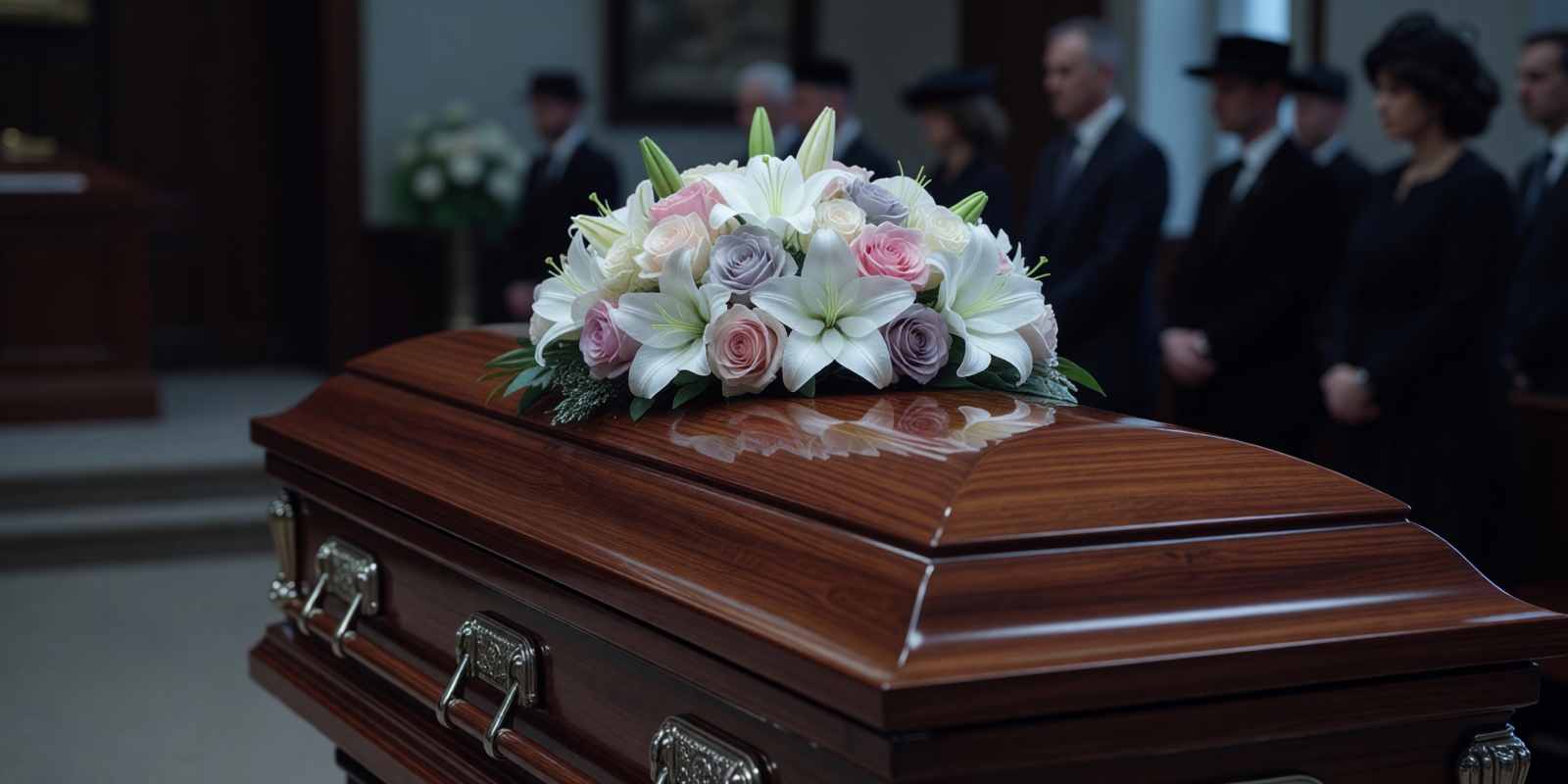

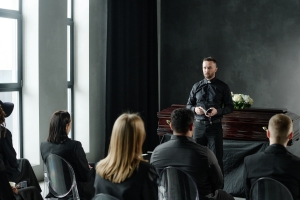
Funeral services come in all shapes and sizes. You may have been to a service in a banquet hall, a brewery, or somebody’s backyard, or seen one with a slideshow instead of a sermon and a close friend at the microphone instead of a clergy member.
You may have wondered what happens behind the scenes of a nontraditional service.
We hear some version of that question from prospective students constantly. Funerals today reflect the culture and personality of the person being honored and may look completely different than conventional services of the past. Students want to know whether a degree program prepares you for the shift.
At the American Academy McAllister Institute of Funeral Service (opens in a new window), we’ve been educating and preparing funeral service professionals for over 90 years. We’ve seen how the industry is changing, and our program teaches both the scientific disciplines that are needed, as well as the family-focused care and bereavement support that our communities have come to expect.
What Families Actually Request
One major change is how people are asking for their remains to be treated. The National Funeral Directors Association (opens in a new window) noted a U.S. cremation rate of 63.4% for 2025, against a burial rate of 31.6%.
Cremation changes service logistics in a number of ways, because it gives everyone more time. A traditional burial compresses everything into a few days. With cremation, families can more easily gather at a time that feels appropriate for everyone, and in a venue of their choice.
The 2026 Consumer Awareness and Preferences Study (opens in a new window) found that 48% of consumers are open to working with a certified celebrant, up from 36.3%. Separately, 62.1% said they have already attended a service led by someone other than a faith leader, and about 30% named a banquet hall as their preferred setting.
While traditional practice is still important, funeral directors are more and more being asked for nontraditional services, which can include lining up a room rental, a caterer, and a sound system.
Where Personalization Fits into an Accredited Curriculum
The American Board of Funeral Service Education (opens in a new window) requires accredited programs to include a minimum of 14 semester credits in public health and technical coursework covering chemistry, microbiology, human anatomy, pathology, restorative art, and embalming.
The requirement for business management and professional coursework is larger, at 16 semester credits. That portion covers funeral directing, funeral merchandising, cremation, accounting, small business management, professional communications, and Federal Trade Commission regulation.
Another six credits are required in the social sciences and humanities, including sociology, the history of funeral service, and funeral service psychology and counseling.
Legal, ethical, and regulatory coursework accounts for at least three more credits.
In total, more credits are required in management, communication, and family care than in clinical preparation. Graduates and practitioners need to be able to sit with a grieving family, ask the right questions in a compassionate way, and come away with a plan that memorializes the person appropriately while also giving families a real estimate of the costs.
The Arrangement Conference Is Where the Work Happens
Accredited programs require students to observe or assist in at least five arrangement conferences, with at least three from specified categories. That requirement used to target the practical side of traditional funerals. Students helped families select a casket and other arrangements, while the funeral director’s attention was mostly on other aspects of the service.
In the past 10 years, that exercise has grown to include much more detail about the design and logistics of a service. Where it will be located, how it will be decorated, what music might play, and the kind of catering are all questions that funeral directors are answering more than they used to.
A student has to learn to ask open questions and listen to the details. And they have to know what a request costs, because a personalized service still gets priced honestly and delivered inside a budget the family agreed to.
Students need religious and cultural practice in enough depth to know what is negotiable and what isn’t. And they often have to run an event in a building that was never designed for a funeral service and where the staff is unfamiliar with the formalities of the service.
Learning to draft remarks, sequence the program, and help a grieving family member through a short speech are all important aspects of contemporary funeral services.
The Sciences Still Set the Floor
Accreditation standards require every student to take an active part in at least 10 embalming cases, including raising vessels, mixing and injecting fluid, cavity treatment, suturing, and feature posing.
Restorative art requires laboratory work. Public health coursework is not optional, and the National Board Exam tests the sciences section separately from the arts section.
What differs between programs is how far past that minimum the clinical load goes. Some build a heavy clinical component that assumes a student is on campus and free to take cases on short notice. Others hold to the accreditation standard for clinical work and go deep on the sciences academically, which maintains the integrity of the degree while making it more accessible to someone working while going to school.
What Licensure and the First Years Actually Require
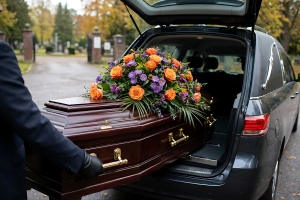
According to the Bureau of Labor Statistics (opens in a new window), most states require a candidate to be at least 21 years old, to graduate from an accredited funeral service or mortuary science degree program, to pass a state or national board examination, and to complete an internship or apprenticeship lasting one to three years. In the Northeast, practitioners often work in more than one state, which requires multiple licenses.
While Colorado has historically been an outlier with voluntary certification, that will change in 2027. Recent legislation means that funeral directors, embalmers, mortuary science practitioners, cremationists, and natural reductionists in Colorado will need to be individually licensed.
The internship can be underestimated by people who change careers. It is paid work, but it is early-career pay, and it usually comes with being on call nights and weekends.
The Bureau of Labor Statistics projects 4% employment growth for funeral service occupations from 2025 to 2035, with roughly 5,600 openings each year.
The net gain over the decade is only about 2,200 positions, so most of that hiring reflects retirement and turnover rather than expansion. As of May 2025, the median annual wage was $61,410 for funeral service workers overall, $55,010 for morticians, undertakers, and funeral arrangers, and $78,790 for funeral home managers.
Who Is Entering the Field Now
A large share of current students are career changers in their 30s and 40s, military veterans, and nurses and other healthcare workers. Each background brings different transferable skills.
Veterans, for example, bring protocol discipline and composure under pressure. Many healthcare workers have already sat with families on the worst day of their lives. Both groups usually need a program that fits around work they already have, which is why online and hybrid delivery has become the practical default.
If you are weighing a career in funeral service and want to see how the coursework is put together, AAMI’s associate degree in funeral service balances the science a license demands with the family care and service design work the profession increasingly rewards. Apply today (opens in a new window) for a mortuary science degree, or contact our admissions office (opens in a new window) to learn more.