

When people think of funerals and the professionals who guide them, they tend to picture quiet chapels and ceremonial duties, but that image barely scratches the surface of the many available careers in funeral service (opens in a new window). Funeral service professionals actually work in a field that blends business leadership, applied science, legal responsibility, and deeply human care.
Funeral service education helps students understand the real benefits of a funeral service career, including having stability, purpose, and long-term growth opportunities in a licensed and highly respected field.
| In This Article: Learn how funeral service education opens the door to diverse mortuary science career opportunities grounded in skill and service. |
|---|
A Funeral Director Career Overview: Leadership Behind the Scenes
A funeral director career (opens in a new window) extends well beyond organizing services. Funeral directors coordinate logistics from the first call through final disposition. They meet with families, gather biographical information, plan ceremonies, arrange transportation, file legal documents, and supervise staff.
A director’s daily responsibilities often involve a mix of client service, event planning, and regulatory administration.
Filing death certificates, coordinating with physicians for cause-of-death certification, and submitting documentation within state timelines require accuracy and procedural discipline. That legal dimension carries lasting implications for families and public records.
Funeral homes also operate as small businesses. Many professionals move into funeral home business management, overseeing payroll, budgeting, vendor relationships, and pricing compliance.
Federal consumer protection regulations require itemized disclosures and transparent pricing practices, which means directors must understand both ethical standards and operational details.
The Science Behind the Profession
In funeral service education, we see the scientific side of the profession as central to professional preparation. A career in embalming science involves applied anatomy, chemistry, sanitation procedures, and restorative art.
Training programs accredited by national standards incorporate coursework in public health and safety, infection control, and preparation techniques. In our experience, that foundation matters because students need more than textbook knowledge once they begin working in real-world settings.
OSHA standards governing bloodborne pathogens and formaldehyde exposure apply directly to funeral homes (opens in a new window), so practitioners must understand workplace safety, protective equipment protocols, and exposure control planning.
In preparation rooms, the work demands precise instrument handling, strict sanitation practices, accurate chemical use, and the ability to follow each step carefully while adapting to the needs of the case.
We see structured lab training build confidence as students learn to handle instruments properly, follow safety protocols, and respect both technical and ethical guidelines. That technical discipline supports professional credibility and helps protect both workers and families.
Beyond embalming, mortuary science career opportunities available to graduate include directing, crematory operations, restorative art specialization, compliance roles, or management positions. Scientific competence becomes a foundation for advancement, not a narrow specialty.
The Community Impact Funeral Professionals Make
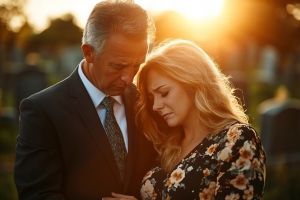
Families often remember funeral professionals for their calm presence during overwhelming moments. Research indicates that families frequently turn to funeral providers for support (opens in a new window) during bereavement, often ranking them alongside family and close friends in perceived helpfulness.
A grief counseling career in funeral service involves listening, guiding arrangement conferences, and helping families design ceremonies that reflect cultural, religious, and personal values. Meaningful rituals can support the grieving process when families choose details such as music, readings, speakers, photo displays, military honors, or faith traditions that reflect the life being remembered. Directors often serve as facilitators of memory and structure during a disorienting time.
The community impact that funeral professionals can create extends far beyond individual services. Many participate in veterans’ honors, public memorials, outreach events, and educational initiatives, with their work supporting public health systems, local recordkeeping, and cultural continuity.
Compassion and time management are equally important. Evening services, weekend arrangements, and on-call rotations demand adaptability. For students who prefer meaningful engagement over routine desk work, that rhythm can feel purposeful rather than burdensome.
Education That Reflects the Profession’s Breadth
The scope of funeral service education (opens in a new window) reflects the complexity, responsibility, and range of demands found throughout the profession.
Accredited programs typically require an associate degree that blends general education with specialized coursework because funeral service professionals are expected to move between technical preparation, legal documentation, family communication, and business responsibilities in the course of everyday work. That combination helps students build the scientific knowledge, ethical judgment, and practical communication skills they need for supervised training, licensure, and long-term success in the profession.
After graduation, students typically move on to supervised practical training and the state licensure process.
The educational foundation of the profession typically includes:
- Anatomy and embalming theory
- Public health and workplace safety standards
- Ethics and legal compliance
- Arrangement conference communication
- Funeral home business management fundamentals
- Grief support principles
Students exploring mortuary science programs (opens in a new window) quickly see that the curriculum spans science, communication, ethics, and business. The academic structure reflects real-world expectations; technical skill, emotional intelligence, and operational awareness develop side by side.
Why Stability and Purpose Matter
Job stability in the funeral service profession remains one of its practical advantages. The U.S. Bureau of Labor Statistics projects steady demand for funeral service workers (opens in a new window), with employment expected to grow 4% from 2024 to 2034 and about 5,800 openings projected each year, on average, over the decade.
That demand is shaped not just by overall growth, but by the ongoing need to replace experienced workers who leave the field, which creates reliable openings for new licensed professionals. Prearrangement planning also supports long-term demand, as federal projections note that funeral service workers will continue to be needed to help a growing number of people plan end-of-life services in advance. For students, that makes funeral service education an efficient path into a stable field with a clear licensure process and long-term professional relevance where they apply scientific preparation, business organization, and compassionate guidance in equal measure.
Purpose-driven students often seek work that holds visible meaning. Funeral service offers that alignment; each case involves real people, real families, and tangible outcomes.
Build a Meaningful Professional Future in Mortuary Science

A career in funeral service is part science, part business leadership, and part community stewardship. Opportunities extend across technical preparation, management, ownership, and family care.
Students who understand the full overview of a funeral director’s career often discover that the profession offers lasting benefits, including stability, intellectual challenge, and the opportunity to serve others with dignity.
If you’re ready to pursue funeral service education that reflects the real demands of the profession, now is the time to act. The American Academy McAllister Institute of Funeral Service prepares students for licensure, leadership, and long-term professional growth through flexible online and hybrid learning options designed for today’s career-focused learners.
Apply to AAMI today (opens in a new window) and begin building a future grounded in skill, compassion, and professional respect. Your path into funeral service starts with a decision, so take that step now.