


A professional who has earned a degree in mortuary science (opens in a new window) bears more responsibility than caring for someone’s remains after death. A fundamental part of the job is also learning to keep yourself, your coworkers, and your family safe from workplace hazards and infectious disease.
The industry has both tools and best practices to help prevent the spread of infectious disease. The Occupational Safety and Health Administration (OSHA) and other regulatory bodies have instituted standards and guidelines. And funeral service curricula offer laboratory coursework and hands-on training to help students internalize safe practices in a monitored environment.
Human Remains Carry Similar Exposure Risks as Living Patients
OSHA’s Bloodborne Pathogens Standard (opens in a new window), 29 CFR 1910.1030, defines a source individual as “any individual, living or dead, whose blood or other potentially infectious materials may be a source of occupational exposure.” This includes bloodborne viruses like HIV and hepatitis, as well as bacteria like salmonella and shigella.
Because of the risk of disease, mortuary science programs teach infection control and how infection control is handled in professional settings.
In classroom settings, students learn to treat every case safely, following the same protocols regardless of what is known about the deceased’s medical history and without making assumptions about their safety. Students leave the program prepared for real-world situations.
They learn, for example, how and why a funeral home that conducts embalming maintains a written exposure control plan and offers the Hepatitis B vaccination to any employee with potential exposure.
What OSHA Standards Require Inside the Prep Room
Bloodborne pathogen exposure is only part of the safety picture in mortuary science. Students also learn how to work with the hazardous chemicals used in the industry.
For example, embalming fluid typically contains formaldehyde, a known carcinogen that OSHA regulates under 29 CFR 1910.1048 (opens in a new window). The standard limits permissible exposure to 0.75 parts per million as an eight-hour average and 2 parts per million over 15 minutes.

Once exposure to formaldehyde reaches an action level of 0.5 parts per million, employers are obligated to begin medical surveillance, including annual health questionnaires and pulmonary function testing for anyone who wears a respirator.
Because embalming work can expose a practitioner to formaldehyde concentrations well above the permissible limit, mortuary science safety training should educate students on ventilation practices, respirator fit, and exposure monitoring. This will both teach the students how to protect themselves in the normal course of their work, and also what to look for in a prep room that meets federal standards.
Sanitation as a Course of Study
The American Board of Funeral Service Education, which accredits funeral service and mortuary science programs (opens in a new window) nationally, requires a dedicated microbiology course built around sanitation, disinfection, public health, and embalming practice. The learning outcome of the course asks students to apply public health and safety principles directly to the handling and preparation of human remains.
In practice, this means students study how pathogens survive on surfaces and instruments, how disinfectant concentrations are calculated and mixed correctly, and how arterial and cavity treatment chemicals interact with the body during preparation.
This coursework is done in tandem with the arts and family care instruction, an aspect of the profession that is becoming increasingly important. A funeral director must be able to speak with a grieving family at a human level, but providing a safe working environment for their staff is equally essential. Mortuary science programs at AAMI teach students both aspects.
From the Classroom to the Prep Room
Reading about an exposure control plan and understanding its technical details is one thing. Executing that plan when under pressure requires a different set of skills. That difference is why hands-on laboratory work is foundational to funeral service training.
Students at AAMI practice putting on and removing personal protective equipment in the correct sequence, mixing disinfectant solutions to the right concentration, and disinfecting instruments and surfaces between cases, until the sequence becomes automatic.
Repetition like this builds more than technique. Students learn how to gain the composure to follow a safety protocol correctly on a difficult case, at an inconvenient hour, without a supervisor standing over their shoulder. Confidence in a prep room develops through iteration, doing the task correctly enough times that muscle memory takes over and hesitation disappears.
Carrying This Preparation Into the Profession
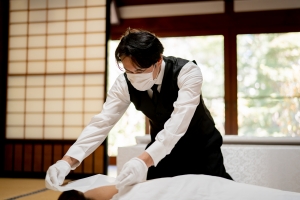
A new funeral service professional will not always have someone checking their equipment or double-checking a disinfectant ratio. Programs need to build safety instruction around the federal standards a graduate will actually work under, to prepare them for the job as it exists.
The Funeral Service associate degree offered at American Academy McAllister Institute is grounded in the technical practicalities of keeping workspaces safe from all manner of hazards, including infection. We pair that training with instruction in the arts and family care practices that are so important to the experience of the grieving family and friends.
We offer flexible online and hybrid options, financial aid support, and a commitment to help our students succeed as they move forward with purpose.
If you are considering a career in the mortuary sciences, apply to AAMI today (opens in a new window) and take your next step toward a meaningful career in funeral service.
American Academy McAllister Institute of Funeral Service (AAMI) and the Funeral Service associate degree program offered by AAMI are accredited by the American Board of Funeral Service Education (ABFSE), 992 Mantua Pike, Suite 108, Woodbury Heights, NJ 08097 (816) 233-3747. Web: www.abfse.org.