
For those considering a career change or exploring funeral service education, questions often arise about the opportunities available in this field. The funeral service profession offers a wide variety of paths beyond traditional funeral directing, allowing students and career changers to align their skills, interests, and goals with a rewarding and stable career.
Expanding a career from the starting point of a mortuary science degree isn’t difficult. Many graduates elaborate on one of their main interests, such as embalming or forensics, to seek out new careers that fit their skillset. Others use internships and mentorships as opportunities to branch out even further and discover new ways to apply their degrees to more rewarding (and more profitable) tasks.
Why Look Beyond Funeral Directing?
Funeral directing is a rewarding profession enjoyed by many graduates of mortuary science. However, some new professionals seek alternative roles to achieve a more flexible schedule, fulfill another passion, or specialize in a part of the field that interests them, such as forensics, education, or entrepreneurship.
This applies not only to recent graduates but also to career-changers who want work that excites and interests them later in their careers. While funeral directing can be a lifelong passion for some, others in the funeral service industry aspire to express their compassion and technical skills in other ways.
Careers Within The Broader Funeral Service Industry
When branching off from funeral directing, funeral service professionals can consider these respectable, interesting careers as starting points:
1. Embalmer (Specialist)
- Embalmers focus on the preparation and preservation of the remains of the recently deceased. As a funeral home director, many professionals oversee the embalming process, but the scientific and technical aspects of the job fall to a specialist.
- Typically, they have low pressure schedules with few or no responsibilities related to running the business.
- Standalone embalming services and trade embalmers also provide opportunities to focus on the science and anatomy aspects of their field.
2. Crematory Operator
- Crematory operations are integral parts of many successful funeral services.
- As demand for cremation services increases (they now account for dispositions at double the rate of burials in the U.S.), funeral homes need more qualified professionals in cremation chamber operations.
- This job requires technical skill in device operations, strict record-keeping, and regulatory compliance on both the operation and documentation sides.
3. Restorative Art Specialist
- Restorative art specialization involves the task of reconstructing remains in case of open-casket funerals, trauma cases, and crimes.
- The goal of restorative art is to present an accurate and compassionate service for the loved ones of the deceased.
- Professionals in this career must coordinate with funeral homes and, in some cases, forensic investigation teams to provide their services.
Students of mortuary science who are interested in the artistic and forensic angles of their degree may enjoy this specialization more than funeral home directing.
4. Pre-Planning Or Advance Planning Consultant
- Pre-planning and advance planning consultants fill an important role in the operations of funeral homes, helping plan services in advance.
- This career requires a combination of sales experience, communication skills, and death literacy. Professionals must be able to balance emotional subjects such as terminal illnesses during the sales process of funeral services to those in need, maintain compassion for their situation, and ensure accuracy in how the services are priced and represented.
5. Mortuary Transport Technician

- Mortuary transport technicians are responsible for respectfully removing and transporting deceased individuals.
- This career path could serve as an entry point into the field of funeral services for those with less experience or undecided on a specific focus, or as a long-term role for those attracted by its distinct benefits, such as travel and schedule flexibility.
6. Funeral Home Management
- Funeral home management differs from directing since management focuses on the day-to-day business operations of the home while directing deals more with the funeral services themselves.
- Managers will have a strong business acumen for operations, finances, staff needs, and customer service issues.
This can be a promising career for mortuary science graduates who want to focus on business, leadership, and employee management, especially if they plan to own a funeral home of their own someday.
Specialized & Allied Professions
In addition to these careers in funeral services, the scope of mortuary science experience can extend into other fields, interests, and career paths, including:
1. Death Investigator Or Coroner
- Requires additional training in forensics or law, depending on the jurisdiction.
- Both positions investigate causes of death, often in collaboration with law enforcement and pathologists.
- Uses mortuary science knowledge to understand human anatomy during investigations and for establishing timelines of death.
2. Organ/Tissue Donation Coordinator
- Organ and tissue donation coordinators work with hospitals and the families of donors to manage the logistics of organ donation.
- This requires clinical experience in anatomy, overlapping with mortuary science, as well as communication skills surrounding issues of death, funeral processes, and compliance.
3. Pathology Or Autopsy Technician
- Pathology and autopsy technicians work closely with medical examiners and pathologists to conduct autopsies and collect specimens, often for hospitals and county coroner offices.
- This career may be a good direction for mortuary science graduates who are interested in criminology and healthcare as it intersects with their human anatomy studies.
4. Forensic Mortuary Services
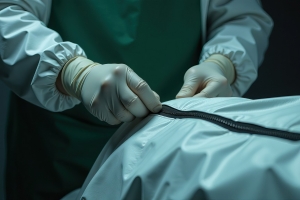
- Forensic mortuary services refers to the specific career of working for Disaster Mortuary Operations Response Teams (DMORTs) or assisting criminal investigations.
- These professionals respond to mass casualty events such as terror attacks or accidents, or in cases requiring high-level reconstructive skills, such as important crime cases.
- This career path can be compelling for those willing to acquire the additional certification and security clearances needed.
Support Your Career Goals With Education In Funeral Services
Every career on this list offers mortuary science graduates and career changers the opportunity to pursue meaningful work in funeral service, combining professionalism with compassion. AAMI is a nationally recognized, premium funeral service education provider, offering flexible, career-focused degree programs both online and on-campus. Our programs, including clinical practicums, are designed to prepare graduates for a variety of roles in funeral service, regardless of their interests, niche, or career goals.
Are you ready to take the next step in your funeral service career? Apply now or contact our team to learn more about our accredited programs and how they can help you launch a stable, rewarding career.