


In the first year of earning a mortuary science degree (opens in a new window), students often wonder if they can handle the material. Embalming labs, anatomy, funeral law, and other fundamental courses are each challenging in their own ways.
But somewhere in the second year, as students get more confident, they turn their attention to the future. They start to ask themselves what separates the graduate who spends 15 years as a staff funeral director from the one who runs a crematory operation or builds a practice around advance planning.
Someone with a degree in mortuary science, a passing score on the National Board Examination, and a completed apprenticeship has met the minimum competency your state requires to serve families. What happens next often comes down to certification.
| In this article: Licensure proves you meet your state’s minimum standard to serve families, but certification is what signals specialization. This guide walks through the major credentials available to mortuary science graduates, what each requires, and how to pick the ones that match the firm you work for and the career you want. |
|---|
What Licensure Covers and What It Does Not
Continuing education in funeral services is already mandatory in most states. New York, for example, requires registered funeral directors to complete 12 minimum hours every two years (opens in a new window), at least two of them on state laws and regulations affecting funeral directing, embalming, and preneed arrangements. Half have to be live classroom instruction.
Professionals in funeral services will be spending hours in coursework each year. What can vary is whether those hours contribute toward something bigger. For example, accredited coursework and home study can count toward New York’s 12-hour requirement as well as toward the Certified Funeral Service Practitioner’s academic category (opens in a new window) at the same time, which means a course you take to keep your license current can also move you toward a designation.
The credential isn’t free but you can offset your costs while growing your career.
The General Credential for Career Funeral Directors
The Certified Funeral Service Practitioner designation (opens in a new window), awarded by the Academy of Professional Funeral Service Practice, is the highest voluntary professional recognition available to a working funeral director. Think of it as a documented record of lifelong professional development rather than a narrow specialty.
Candidates accumulate 180 hours (or 18 continuing education units) across academic work, professional activities, public education, and career review. Academic work covers higher education, research, and accredited home study and can account for up to 108 hours of the total.
New applicants can also claim up to 54 hours of retroactive credit (opens in a new window) for experience gained between licensure and Academy membership. After that, it takes 20 documented hours a year to maintain.
The designation makes sense for graduates who plan to stay in general practice.
Cremation Certification Has Become a Practical Requirement
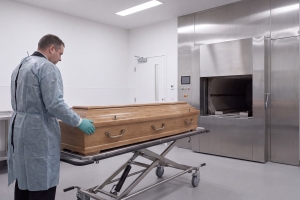
The National Funeral Directors Association reported an estimated national cremation rate of 63.4% for 2025 (opens in a new window), with burial at 31.6 percent. It expects cremation to hit 82.3% by 2045. Every state and the District of Columbia are projected to pass 50% by 2035.
This means that crematory operator training and certification is increasingly important. The Cremation Association of North America’s Crematory Operations Certification Program (opens in a new window) is available both online and in-person. It covers flame and water cremation, equipment, chain of custody, documentation, legal exposure, and environmental compliance. Certificates last five years.
Some states have not yet adopted the CANA program as their official training standard, and New York requests state-specific instruction on top of it. Ask your board before you commit to a class.
Family-Facing Specializations
Certified Celebrant training, developed by the InSight Institute and hosted through the National Funeral Directors Association and several state associations, prepares directors to design and lead personalized services for families with no clergy relationship, or who want something outside a religious framework.
The Certified Preplanning Consultant (opens in a new window) credential has been administered by the National Funeral Directors Association since 1997 and covers advance planning. It is self-study with a standards manual, chapter review tests, and a final online examination, with six months to finish after you enroll.
Licensed funeral directors don’t have to meet any minimum preplanning employment requirement to apply. Renewal comes every four years with 24 contact hours of continuing education.
Grief Education as a Separate Discipline
The Certification in Thanatology (opens in a new window) from the Association for Death Education and Counseling runs across four tracks depending on your academic background. The required thanatology experience ranges from 1,760 hours if you hold a bachelor’s degree or higher in a social, behavioral, or health science, and up to 5,280 hours if your degree is outside those fields.
Students need 90 contact hours of thanatology education, letters of recommendation, and a passing exam score. Recertification is 45 contact hours every three years, which can be split across continuing education, teaching, and volunteering.
This certificate matters most to graduates moving toward aftercare programming, bereavement facilitation, or hospice partnership work, and it carries weight well outside funeral service.
Management Credentials and the Earnings Gap
The Bureau of Labor Statistics (opens in a new window) separates funeral service into two occupational categories. Funeral home managers earned a median of $78,790 in May 2025. Morticians, undertakers, and funeral arrangers earned $55,010. Employment for the industry is projected to grow 4% from 2025 to 2035, with roughly 5,600 annual openings.
The International Cemetery, Cremation and Funeral Association (opens in a new window) offers six executive designations, among them Certified Funeral Executive, Certified Cremation Executive, and Certified Cemetery Funeral Executive. Each requires five years of employment in the industry with current full-time status, and the program uses a points system that draws on management experience, formal education, association participation, publications, and speaking.
For people who know they want this to be their long-term career, working toward management credentials early can help you achieve higher earnings.
Choosing Certifications That Match Your Goals

Two or three years of licensed practice will help you see which specializations fit your goals. A firm running a 70% cremation rate makes crematory certification an obvious first move. A firm with a large preneed portfolio makes the preplanning credential more immediately useful.
It also helps to know which credentials carry regulatory weight and which work as market signals. Crematory operator training is legally required in a growing number of states. Celebrant training is not yet required anywhere, but it can shape the opportunities you receive.
Building the Foundation First
Before you can start earning work experience and certificates, you’ll need an accredited degree and an active license. Apply today for AAMI’s associate degree in funeral service (opens in a new window) to begin developing that base in both the scientific and family care side of the profession.
Online and hybrid formats let students study around existing work and family commitments, and financial aid (opens in a new window) is available. If you are trying to figure out where a funeral service education could take you, our admissions team can walk you through the program and your state’s licensure pathway.