
Cremation starts with legal authorization. Staff identify the deceased, assign a number, and cremate in a two-chamber cremator before processing the bone fragments and returning them to an authorizing agent. Staff check and document identification at every handoff. Work requiring this level of care and expertise is why cremation training has become a necessary part of preparing for a career in funeral service.
The U.S. cremation rate was projected to reach over 63% in 2025, compared with 31.6% for burial, according to the National Funeral Directors Association (opens in a new window). That number is expected to climb to 82.3% by 2045.
The sequence follows standards from the Cremation Association of North America (opens in a new window) (CANA), and states and facilities vary in timing and documentation.
Authorization and Chain of Identification Start the Process
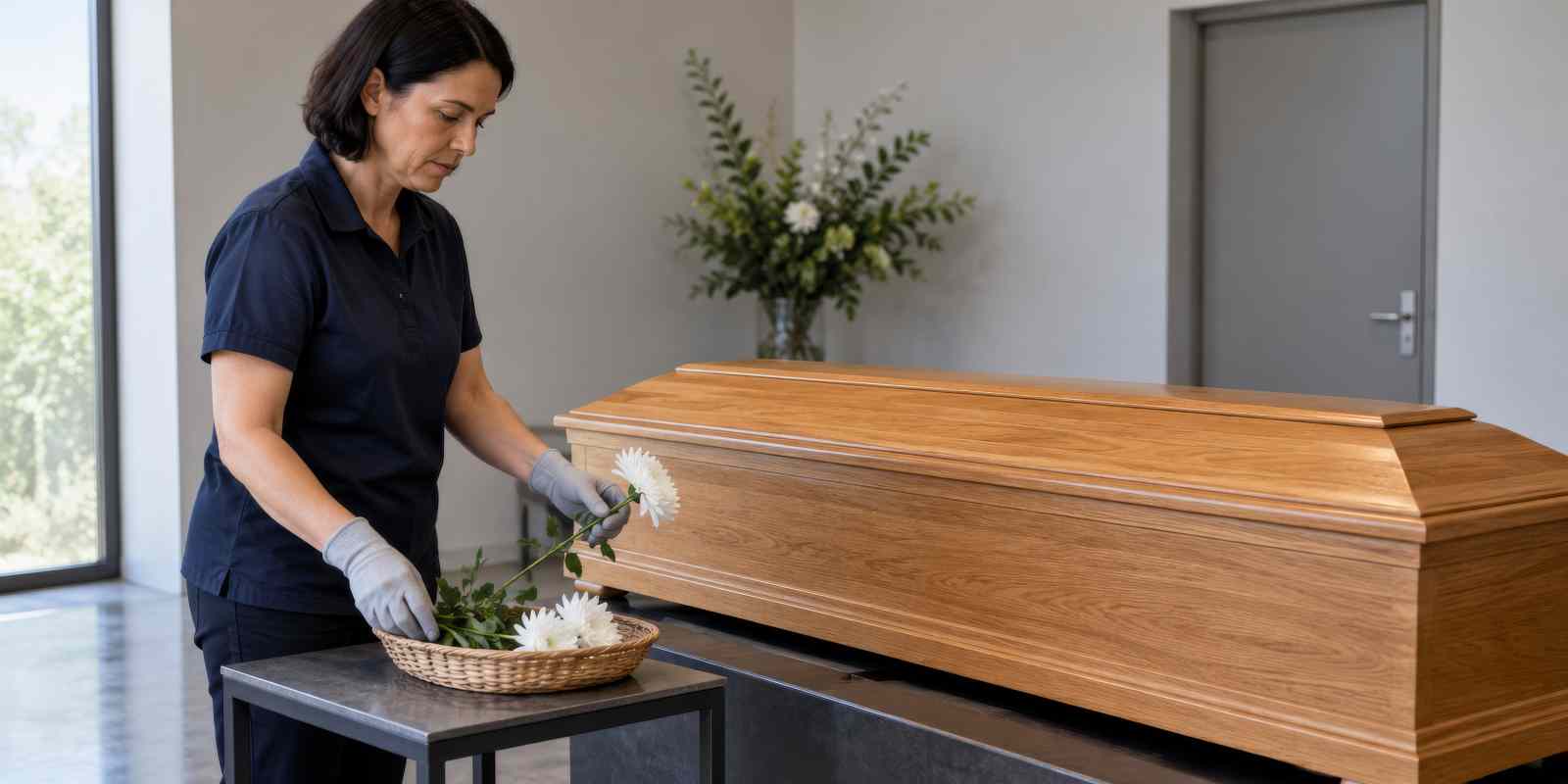
Cremation begins with legal authorization from the person entitled to control disposition of the remains. The deceased is then taken to a funeral home, or on rare occasions, directly to a crematory, and held in secure cold storage while paperwork is finalized and services are planned. Cremation generally takes place no sooner than 48 hours following someone’s death.
At every handoff, staff confirm identity against the paperwork. A stainless-steel disc bearing a stamped number is typically stamped and logged in a cremation record, and that remains with the body throughout its entire stay at the facility.
CANA lists eight identification checkpoints that begin at the place of death and end with return to the authorizing agent. Because cremation is irreversible, CANA also recommends documenting every step, and a funeral director (opens in a new window) explains a facility’s specific procedures to any family that asks.
Medical devices (opens in a new window) such as pacemakers and defibrillators are removed beforehand because their batteries could be explosive in a cremator. Most heart devices are taken out before cremation, usually by a mortician or pathologist.
The Cremation Process Step by Step
- Staff place the body in a cremation container that must be fully enclosed, sturdy, resistant to leaking, and able to burn, which means metal caskets cannot be used.
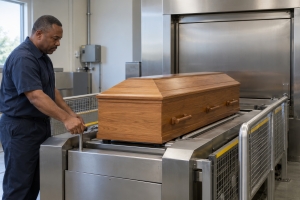
- Staff check the disc against the paperwork, and the container goes into the cremator’s primary chamber with it.
- A technician oversees the cremator, which generally operates at temperatures ranging from 1,400 to 1,800 degrees Fahrenheit.
- When the cycle is complete, staff verify identification once more, collect the bone fragments into a cooling tray, and transfer them to a processor after they have cooled down.
- Staff separate out metal from surgical implants, dental fillings, casket handles, or jewelry, and the processor’s blades reduce the bone fragments to pieces smaller than one-eighth of an inch.
- Staff bag the cremated remains, place them in an urn or temporary container, and check identification once more before holding the labeled container for the family.
Two Combustion Stages Inside the Cremator
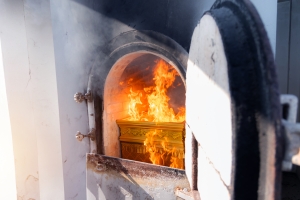
The primary cremation chamber incinerates tissue, organs, body fat, and container materials and converts them to gases, which then pass into a secondary chamber where the burning process is completed. Bone fragments stay in the primary chamber, and gases such as carbon dioxide and water exit through a stack in the crematory roof.
Because cremated remains are pulverized bone fragments, the National Funeral Directors Association recommends against using the term ash. The fragments are mostly calcium phosphates and generally white to gray. Adult cremated remains typically weigh between 4 and 6 pounds on average.
Container and Viewing Choices
No state or local law requires a casket for cremation, according to the Federal Trade Commission (opens in a new window). A funeral home providing cremation services is required to inform families about the availability of alternative containers and must offer them, which can be made from materials like unfinished wood, pressed wood, fiberboard, or cardboard.
Embalming is also not required for direct cremation, although many funeral homes set their own policy of embalming for a public viewing.
Families wishing to attend can make arrangements to observe the cremation process firsthand. Personal items such as jewelry are removed and can be returned with prior arrangement. Some items of significance can be cremated with a loved one, and the funeral director advises on what is eligible, since not everything is combustible.
Cremation Training in Mortuary Science Careers
Many states (opens in a new window) require certification for those who perform cremations, and funeral directors coordinate each one with the crematory. The Bureau of Labor Statistics lists an associate degree in funeral service or mortuary science (opens in a new window) as the typical education, along with one to three years of supervised training and a state licensing exam. About 5,600 openings for funeral service workers are projected each year through 2035, many of them to replace workers who retire or change occupations.
At AAMI, the associate degree curriculum (opens in a new window) lists Crematory and Cemetery Operations and Federal Trade Commission for Funeral Service among its areas of study.
Start Your Funeral Service Career at AAMI

AAMI’s associate degree in funeral service offers accredited funeral education online or on campus, and students may complete it in 12 to 24 months. Financial aid is available to eligible students. The program is academically demanding in the sciences, and clinical requirements meet industry standards.
Prospective students, including career changers and military veterans, can call (212) 757-1190 or toll-free at (866) 932-2264, or reach AAMI online (opens in a new window). The admissions team is glad to talk through the application process and what a career in funeral service involves.