A career in funeral service begins long before the first day in a funeral home, and understanding mortuary science degree requirements sets the tone for everything that follows.
Education in this field is structured, regulated, and tied directly to licensure eligibility, which makes early clarity especially valuable. Students who understand expectations up front tend to progress through school and licensing steps with greater confidence and fewer delays.
| In This Article: You will gain a clear, practical breakdown of mortuary science degree requirements, including education prerequisites, accreditation standards, hands-on training expectations, and licensure preparation steps that shape a successful path into funeral service. |
Understanding Mortuary Science Degree Requirements
Mortuary science is a licensed profession that’s regulated by a combination of state law and national education standards.
Entry into the field requires formal education because funeral directors and embalmers handle legal documentation, public health responsibilities, and deeply personal services under strict oversight.
Clarity around mortuary science education requirements before enrollment helps students avoid programs that do not align with licensure goals.
Today’s guide provides a detailed overview of academic prerequisites, hands-on training, accreditation standards, and licensing preparation to help prospective students plan responsibly.
What Is a Mortuary Science Degree?
A mortuary science degree, sometimes called a funeral service degree, prepares students for professional roles that combine science, administration, and family care. Coursework supports careers as funeral directors, embalmers, or dual-licensed professionals, depending on their respective state regulations.
Degree programs are typically divided into two components: general education coursework, which strengthens communication and analytical skills, and professional coursework, which addresses embalming, restorative art, law, ethics, and funeral service operations tied directly to funeral service degree requirements.
Accreditation Requirements for Mortuary Science Programs
Accreditation plays a central role in licensure eligibility and exam readiness. State licensing boards frequently require graduation from an accredited mortuary science program before candidates may advance toward licensing exams or supervised training.
Accredited programs follow nationally recognized curriculum standards and track outcomes related to employment and examination performance.
Choosing an institution such as the American Academy McAllister Institute helps students align their education with regulatory expectations and industry-wide professional benchmarks.
Admission Requirements for Mortuary Science Programs
Admission requirements vary by institution, although most programs require a high school diploma or equivalent. Applications typically include transcripts and documentation demonstrating readiness for both college-level science and professional study.
State licensing laws can influence admissions advising, particularly around age and postsecondary education expectations.
Early awareness of mortuary science program requirements allows applicants to choose schools that support long-term licensure goals rather than short-term enrollment convenience.
Core Coursework in a Mortuary Science Degree Program
Mortuary science coursework places a dual emphasis on scientific knowledge and the professional responsibilities inherent in the work. Foundational subjects commonly include anatomy, microbiology, embalming chemistry, pathology, and restorative art.
Professional coursework supports ethical practice and legal compliance through instruction in funeral service law, management, and consumer protection. Academic rigor reflects the reality that graduates are expected to perform technical tasks safely while meeting regulatory standards.
Funeral Service & Mortuary Science Technical Training
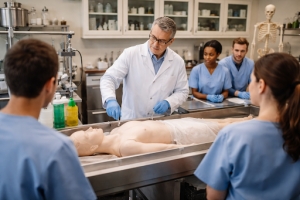
Technical training transforms classroom instruction into an applied skill. Embalming labs and preparation room instruction teach students arterial injection, cavity treatment, sanitation procedures, and restorative techniques under supervision.
Embalming training requirements heavily emphasize hands-on learning. Programs assess competence through documented participation in embalming cases, reinforcing professional expectations encountered in real funeral home environments.
Funeral Service Law, Ethics & Professional Standards

Law and ethics instruction addresses the regulatory framework governing general funeral service practice. The coursework covers pricing disclosures, documentation requirements, and state and federal oversight responsibilities.
Ethical judgment receives focused attention because funeral professionals serve families during emotionally intense moments. Professional standards taught during training influence how graduates manage compliance, transparency, and accountability throughout their careers.
Communication & Family Support Training
A successful funeral service depends heavily on having solid communication skills. Programs train students to conduct arrangement conferences, explain service options clearly, and support families without pressure or confusion.
Instruction emphasizes listening, empathy, and professional boundaries. These skills directly align with funeral director education requirements and the daily interactions with grieving families and community members.
Clinical, Practicum, or Applied Learning Requirements
Applied learning strengthens readiness for professional environments. Many programs integrate supervised clinical experiences in which students participate in embalming cases and preparation room operations under structured oversight.
Practical training reinforces classroom knowledge and builds familiarity with workplace expectations. Graduates who complete verified applied learning often transition more smoothly into post-graduation internships or residencies required by licensing boards.
Preparing for the National Board Exam
The National Board Exam represents a major milestone in the licensing process. Exam content reflects entry-level professional tasks across both arts and sciences domains.
Effective programs align mortuary science coursework with tested subject areas and provide structured National Board Exam preparation. Academic assessments that mirror exam content help students approach licensure testing with greater confidence.
State-Specific Licensing Considerations
Degree completion supports licensure preparation, although state approval involves additional steps beyond graduation. Many states require a supervised training period after the degree is completed, often lasting anywhere from one to three years.
Licensing rules vary by jurisdiction and by professional role. Taking the time to conduct early research on state requirements helps students align education timelines with supervised training expectations.
Time Commitment & Program Length
Associate-level mortuary science programs generally require at least two years of postsecondary study. Accreditation standards specify a minimum of 60 semester hours, aligning with many state education thresholds.
Flexible scheduling options support both working adults and potential career changers. Online and hybrid formats allow students to balance education with employment or family responsibilities while progressing toward licensure.
Career Outcomes After Completing a Mortuary Science Degree
Graduates often pursue roles as funeral directors, embalmers, arrangers, or crematory professionals once licensed. Federal labor data shows steady demand for funeral service workers, with thousands of openings projected annually due to workforce replacement.
Career readiness depends on applied skills, regulatory knowledge, and communication ability. Programs designed around these competencies support long-term professional stability.
Choosing the Right Mortuary Science Program

Program evaluation should focus on accreditation, curriculum alignment, and student support structures. Having clear documentation of applied learning and licensure preparation helps reduce uncertainty during and after enrollment.
Thoughtful selection protects both time and financial investment. Programs that openly address licensing pathways and exam readiness help students make informed decisions.
Prepare for Professional Success With AAMI
Students seeking clarity around mortuary science degree requirements benefit from accredited education that’s built around professional preparation. The American Academy McAllister Institute offers academically rigorous instruction, flexible learning options, and focused licensure preparation aligned with industry standards.
Learn how AAMI supports each stage of your mortuary science education and helps prepare you for confident entry into funeral service at AAMI.edu.